



Lift Sling Net Belt Factory · Technical Brief
Anti-Drone Netting: Choose Knotted Aramid Anti-Drone Net to Truly Defend Against Drones
Steel wire mesh looks like the obvious answer to a drone overhead — until you read the joint strength on the supplier's own data sheet. One tonne of aluminium ferrule against seven tonnes of knotted aramid rope.
The drone war did not arrive with a new weapon. It arrived with a new delivery method. A quadcopter that costs less than a rifle now carries a 60 mm mortar bomb, a shaped charge or a thermobaric grenade to a trench, a vehicle park or a fuel point, and it does so without a pilot in line of sight — and increasingly without a radio link at all. Fibre-optic spools and pre-programmed waypoints have retired the comfortable assumption that jamming is enough.
That leaves physical barriers, and among them the net is the only one that works whether or not the electronic warfare does. Which raises a procurement question that is usually settled on price and a photograph: steel wire rope mesh, or knotted aramid netting? The two look alike in a catalogue. In the only number that decides whether a net holds, they differ by a factor of seven.
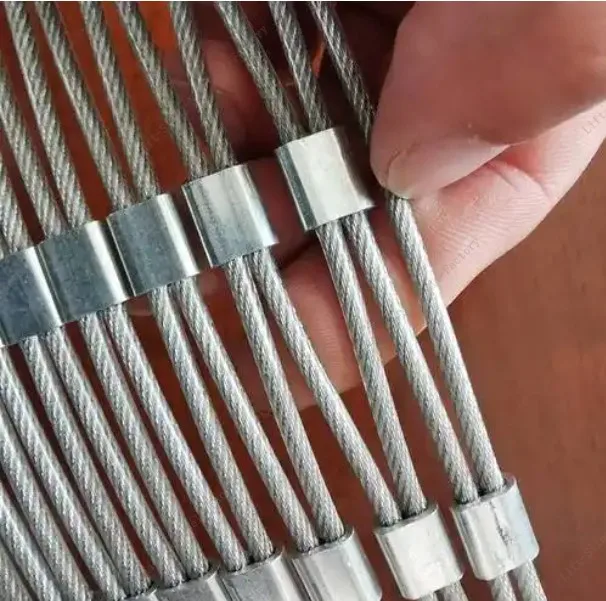
The weak link in steel wire mesh is not the wire
Steel mesh is made by crimping aluminium ferrules onto stainless wire at every crossing. The wire itself is respectable: a 4.0 mm 7×19 SUS 316 rope breaks at roughly 8 kN on its own. The ferrule does not. Our own specification sheet for clamped stainless mesh — industry reference values, translated here from the Chinese original — gives the joint figures the trade actually works to.
| Rope Ø (mm) | Strand | Ferrule / joint type | Joint min. breaking force | kN | Tonnes |
|---|---|---|---|---|---|
| Rope diameters offered | |||||
| 1.2 / 1.6 | 7 × 7 | — | no ferrule rating published | — | — |
| 2.0 | 7 × 7 | DIN EN 13411-3 double ferrule | 265 kgf | 2.6 | 0.27 |
| 2.4 (3/32 in) | 7 × 7 | DIN EN 13411-3 double ferrule | 4.18 kN (426 kgf) | 4.18 | 0.43 |
| 3.0 | 7 × 19 | DIN EN 13411-3 double ferrule | 552 kgf | 5.4 | 0.55 |
| 4.0 | 7 × 19 | DIN EN 13411-3 double ferrule | 981 kgf | 9.6 | 0.98 |
| 6 / 8 / 10 / 12 | 7 × 19 | — | no ferrule rating published | — | — |
| Material and notes | |||||
| SUS 304 / 304L / 316 / 316L. Values are minimum breaking force of the ferrule joint, not of the rope. A pressed ferrule must not be re-bent or re-used; for dynamic, shock or personnel duty take 1/5–1/6 of the breaking force as the working load, and inspect for loosening, deformation and corrosion. | |||||
Table 1 — Steel wire rope mesh: rope range and ferrule joint strength (translated from the factory specification sheet).
Read the 4.0 mm row. The largest standard ferrule in the table, pressed onto 4.0 mm rope, fails at 981 kgf — 9.6 kN, about 0.98 tonne. That is the ceiling of a clamped steel mesh, and the ceiling is a cold-formed aluminium sleeve, not the wire. For the 6, 8, 10 and 12 mm ropes that mesh is often drawn with, no ferrule rating is published at all, because at that size the joint is no longer the rope's equal in any useful sense.
Three further properties follow from the material rather than the design, and all three matter on a position under drones.
It corrodes exactly where it is crimped. A chloride film sits in the crevice between aluminium sleeve and stainless wire, and that is where pitting begins — the surface looks sound while the joint is going.
It is a radar reflector. A steel net over a position returns a strong echo, detunes the antennas underneath it and attenuates the GNSS, radio and C-UAS links you are relying on. On a site that needs to hear a drone before it sees one, a steel roof is working for the other side.
It fails into fragments. A panel struck by a munition produces steel spall and whip-cracking wire ends at head height, on your own position.
None of this makes steel mesh useless. It is cheap, it is stiff, and against a slow commercial drone at short range it does the job it was designed for. It is simply not the material that should decide a modern counter-drone barrier.
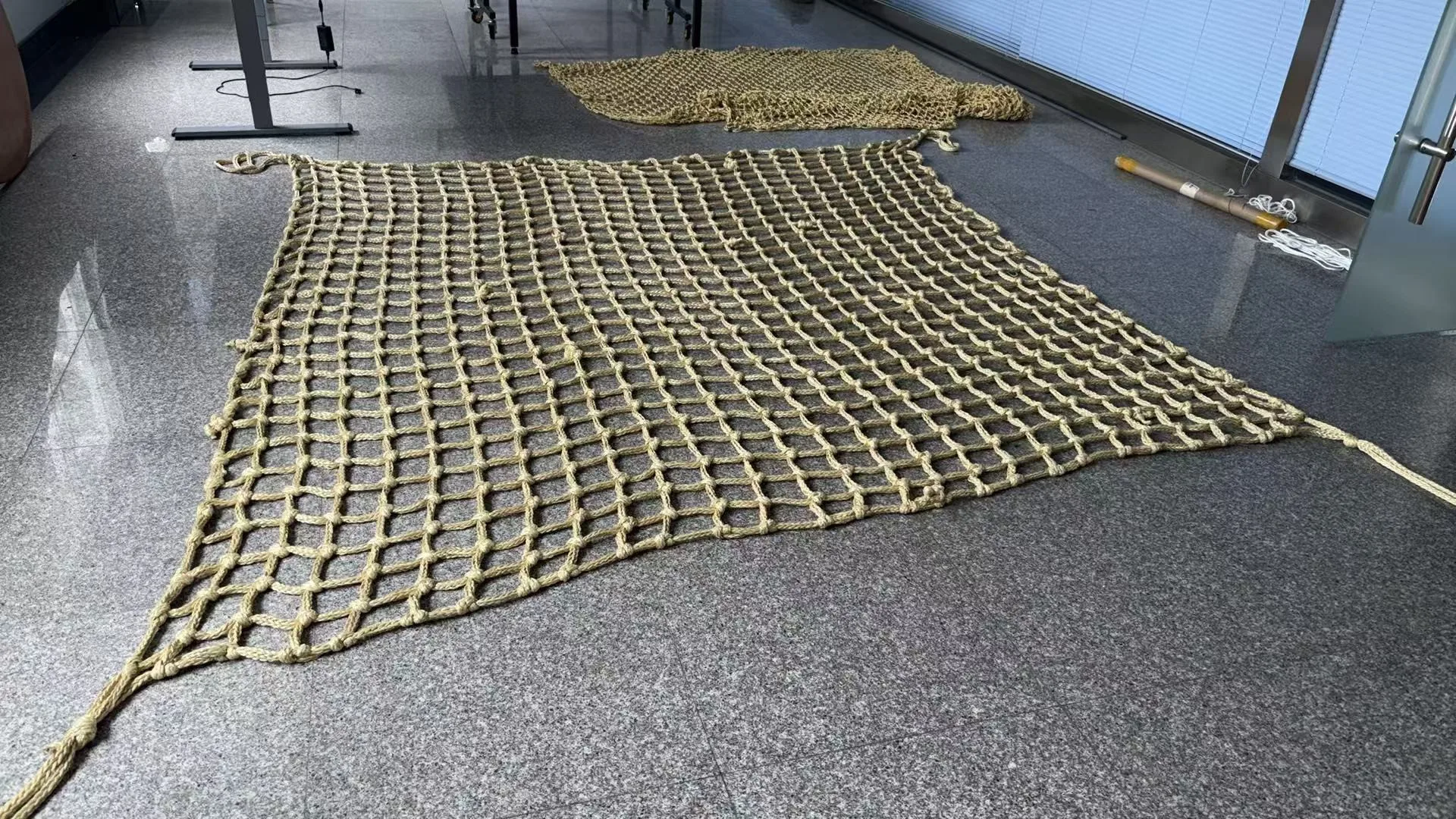
What a knot changes
A knotted aramid net has no ferrule, no swaged terminal and no mechanical joint at all. The knot is formed from the same rope that carries the load, so there is nothing to crimp, nothing to galvanically corrode, and no joint that fails at a fraction of the rope's strength. It also means the net can be repaired where it hangs: cut out the damaged cell, re-knot, re-tension, back in service. A clamped mesh with one failed ferrule is scrap or a workshop job.
Aramid brings three further advantages that matter more in the field than on a specification sheet.
It absorbs impact instead of transmitting it. Aramid has a useful elastic range; steel wire rope is stiff and hands the shock straight to the anchors. A net that stretches decelerates a drone instead of ringing the frame and loading the ground anchors.
It is dielectric and radar-transparent. No echo, no detuning, no radio shadow over your own antennas — and no corrosion at all, in salt air or monsoon.
It weighs a fraction of steel for the same strength. One person carries a 10 × 10 m net. The same coverage in clamped stainless needs a vehicle, two people and gloves.
The numbers, side by side
Two figures come from our own production and are reproduced here without adjustment: a 6 mm aramid rope rated at 2.6 tonnes, and a 10 mm aramid rope pulled to 70.67 kN — 7.2 tonnes — on our horizontal tensile machine on 23 June 2026, sample Dia10mm 26101406. The chart below is the machine's own output, reproduced unedited.
| Net element | Construction | Breaking force (kN) | Tonnes | Against steel mesh |
|---|---|---|---|---|
| Aramid, 6 mm | Knotted aramid rope | 25.5 | 2.6 | 2.7 × |
| Aramid, 10 mm | Knotted aramid rope | 70.67 (measured) | 7.2 | 7.4 × |
| Steel mesh, 4.0 mm + ferrule | Aluminium ferrule joint | 9.6 | 0.98 | 1.0 × (reference) |
| Steel mesh, 3.0 mm + ferrule | Aluminium ferrule joint | 5.4 | 0.55 | 0.56 × |
Table 2 — Like for like: one net element against one net element. Steel figures are the ferrule joint values from Table 1; aramid figures are rope breaking force.
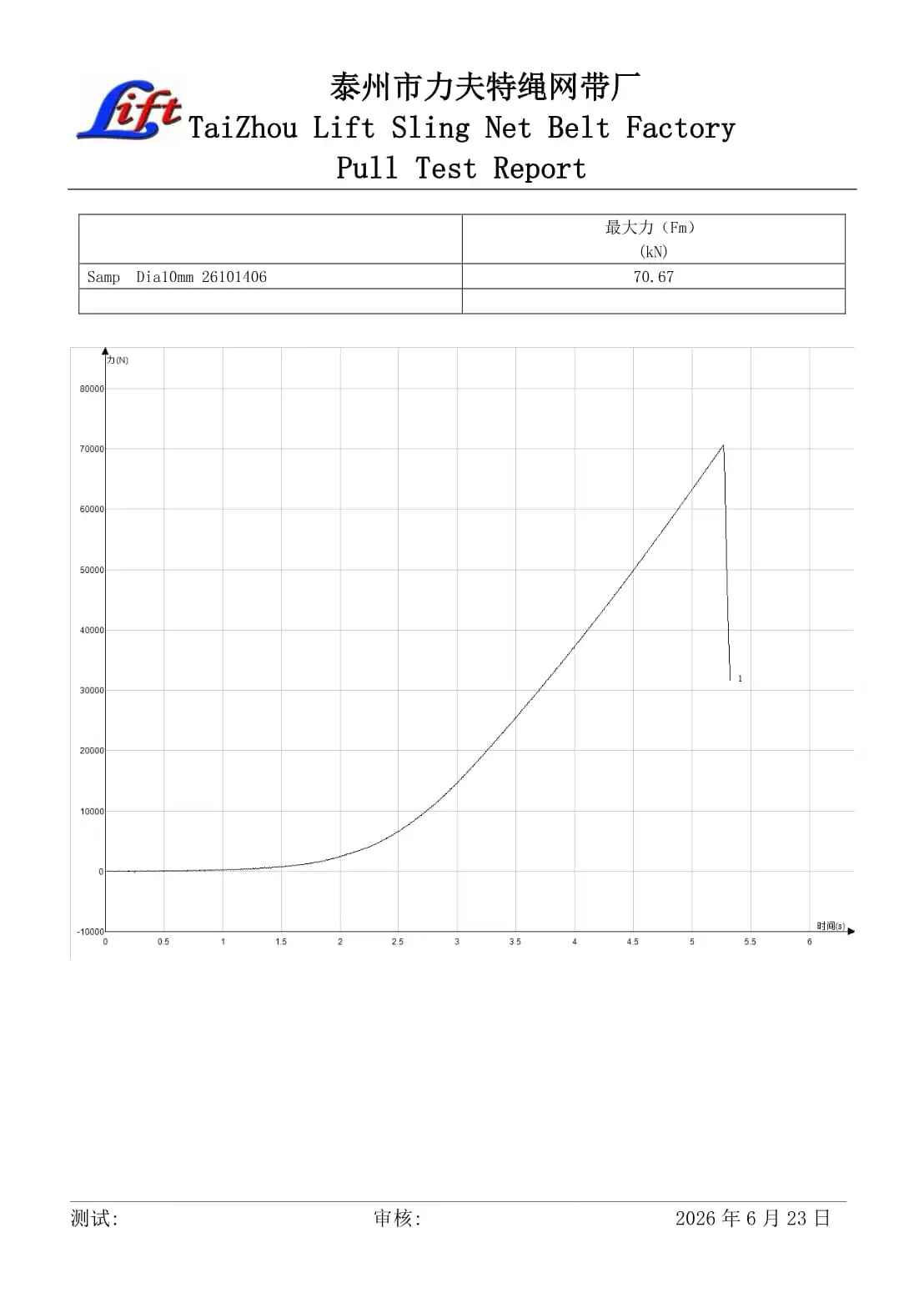
The comparison is element against element. The 10 mm aramid element carries 7.4 times the load of the largest ferrule joint in the steel-mesh sheet. Even the 6 mm element — the lightest rope we supply for anti-drone netting — carries 2.7 times as much.
One point of honesty, because a procurement engineer will raise it anyway: a knot is not a straight pull. Knot efficiency on braided aramid typically runs 50–60 %. Rate the 10 mm net at a conservative 50 % and the joint still holds about 3.6 tonnes — three and a half times the best ferrule in the steel-mesh sheet. Publish the conservative figure and the argument ends there.
What 7.2 tonnes means against a drone
A net does not need to survive a missile. It needs to stop the thing carrying one, and the arithmetic for that is short. The arrest force on a rope that stops a mass m travelling at velocity v over a deceleration distance s is:
F = m·v² / (2·s)
| Threat | Mass | Impact speed | Stop distance | Arrest force |
|---|---|---|---|---|
| 5-inch FPV quadcopter | 1.5 kg | 40 m/s | 0.4 m | 3.0 kN (0.3 t) |
| 60 mm mortar bomb, drone-dropped | 1.3 kg | 80 m/s | 0.4 m | 10.4 kN (1.1 t) |
| 3 kg shaped-charge munition | 3.0 kg | 90 m/s | 0.4 m | 30.4 kN (3.1 t) |
| 5 kg munition, steep dive | 5.0 kg | 100 m/s | 0.4 m | 62.5 kN (6.4 t) |
Table 3 — Arrest force for representative threats, net decelerating over 0.4 m.
The last row is the reason a 10 mm net is specified rather than a 6 mm one. Take the 5 kg case at 62.5 kN and spread it across the four elements of an engaged cell: each sees about 16 kN — less than half of what a knotted 10 mm element carries at a conservative 50 % knot efficiency, and under a quarter of its straight-pull break. The net is not marginal. It sits comfortably inside its rating, which is the only condition under which a barrier is worth hanging.
What a net cannot do is worth stating plainly, because the claim is often made badly. A net does not stop an anti-tank guided missile, and no netting product honestly claims to. What it stops is the delivery: the quadcopter that carries a munition to a parapet, the fibre-optic drone that cannot be jammed, the loitering machine that must hover to aim. Break the delivery and the warhead never arrives — and that is the entire point of netting a position. A 0.98-tonne ferrule on a 7.2-tonne threat leaves that job to luck.
Six design rules that decide whether a net works
Standoff. Keep the net at least 2 m clear of the surface it protects, so a functioning warhead initiates against air rather than the target.
Tension. Pre-tension every edge with a ratchet until the sag is under 5 % of span. A slack net catches the drone and drops it on the thing you were protecting.
Mesh size. Cell no larger than half the drone's rotor span: 100 mm for 5-inch FPV, 150–200 mm for larger airframes.
Two layers, offset by half a cell. The second drone is usually the one that arrives while the first is still tangled.
Load path to ground. Every edge rope to its own anchor. A net is only as strong as the anchors it is tied to, and a 7.2-tonne rope on a 1-tonne stake is a 1-tonne system.
Cover the approach cone, not just the roof. Drones arrive at 30–60°, so extend the net beyond the footprint on the exposed sides.
Where knotted aramid anti-drone netting is specified
Overhead cover for forward positions and trenches; vehicle, plant and aircraft parking; ammunition and fuel points; antenna farms and substations; prisons, border posts and critical infrastructure; event and VIP perimeters. In each case the requirement is the same: a physical layer that keeps working when the electronic one does not, and that fails — if it fails — without producing fragments over the people underneath.
About the manufacturer
Lift Sling Net Belt Factory (TaiZhou Lift Sling Net Belt Factory), Taizhou, Jiangsu Province, China, knots aramid anti-drone netting in-house: 6 mm, 8 mm and 10 mm rope, mesh and panel size to order, edge rope, tensioning ratchets, anchors and repair kits. Every batch is pulled on our own horizontal tensile machine and ships with its test record — the report reproduced on these pages is one of them. The Lift Sling group has manufactured lifting slings and cargo nets since 1985.
Send the span, the height, the mesh size, the rope diameter and the quantity, and we return a quotation with a mesh layout and an anchor plan.
Figures in this brief are the standard build for the ranges shown and are quoted as breaking force, not working load. The sewn or printed label on the net you receive governs. Netting is a passive physical barrier; it is not a substitute for detection, electronic warfare or a site-specific threat assessment.