语言选择: 



The threat is no longer theoretical.
In conflict zones, critical infrastructure sites, and high-security installations worldwide, small commercial drones have evolved from a nuisance into a genuine tactical weapon. Modified to carry explosives or incendiary payloads, they can strike with precision, speed, and near-invisibility to conventional radar. Traditional countermeasures — jamming, kinetic interception, directed energy — are expensive, power-dependent, and often fail against autonomous pre-programmed drones.
A quieter, simpler, and more reliable layer of defense is gaining ground: the physical barrier. And at the heart of that barrier sits an unlikely hero — aramid fiber netting.
A drone strike delivers two simultaneous threats: kinetic impact (mass × velocity at the point of contact) and thermal load (if carrying an explosive or incendiary device). Most synthetic materials fail on one of these fronts — they may absorb a body blow, but melt or ignite under fire. Steel mesh handles heat but is heavy, difficult to deploy rapidly, and prone to corrosion.
Aramid fiber solves both problems in a single material.
With a tensile strength five times that of steel on an equal-weight basis, aramid absorbs and dissipates impact energy without snapping. Its limiting oxygen index (LOI) exceeds 29%, meaning it will not sustain combustion in normal atmospheric conditions. It does not melt — it carbonizes at temperatures above 500°C while maintaining structural integrity. For a drone carrying a grenade-sized payload, that combination of impact resistance and thermal stability is the difference between containment and catastrophe.
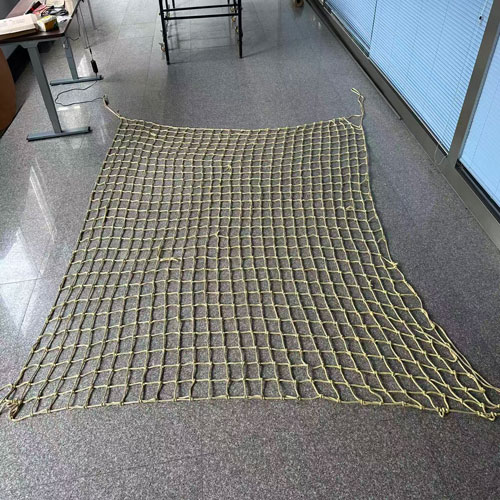
The net's architecture is as critical as the fiber itself. A braided knotted mesh — as opposed to simple woven or knotless netting — offers three decisive advantages:
1. Energy Redistribution
Each knot acts as a nodal point that transfers impact forces laterally across multiple yarns, preventing a single strand from absorbing the entire kinetic load. The braided structure allows controlled elongation, turning a sudden impact into a gradual deceleration zone.
2. Damage Tolerance
If one strand is severed — by shrapnel, flame, or a secondary strike — the knotted junctions prevent catastrophic unraveling. The net continues to function. This is not a one-and-done barrier.
3. Variable Mesh Geometry
Braided knots allow precise control over mesh aperture size. For drone defense, apertures of 40–80mm are typical — small enough to entangle quadcopter rotors and wings, large enough to maintain manageable weight and airflow for permanent installations over sensitive infrastructure.
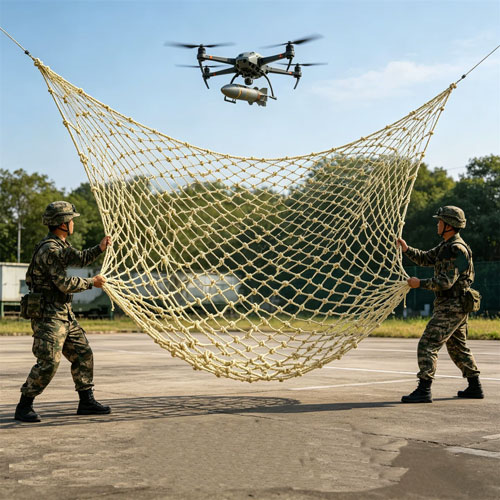
A drone carrying an explosive payload presents a fundamentally different challenge from a kinetic-only threat. The blast generates a high-pressure shockwave, fragmentation, and a fireball — all in milliseconds.
Aramid nets address this in layers:
Primary blast
The net's open-mesh structure allows the shockwave to pass through, reducing reflected pressure that would otherwise tear a solid fabric barrier apart. The fibers absorb fragment impact, catching projectiles that would otherwise travel tens of meters.
Secondary fire
Aramid's inherent flame resistance and high thermal decomposition threshold mean the net does not contribute fuel to the fire. It may char where directly exposed to flame impingement, but it will not propagate combustion across the barrier. This containment buys critical seconds for suppression systems or evacuation.
Residual integrity
Post-blast testing shows properly constructed aramid nets retain 60–80% of their structural load path after localized thermal and fragmentation damage, allowing them to remain a functional barrier for follow-up threats.
Aramid drone defense nets are already in service across multiple domains:
Sector | Application |
Military bases | Perimeter overhead netting over ammunition depots, vehicle parks, and command posts |
Critical infrastructure | Power substation shielding, oil & gas facility overhead protection, water treatment plants |
Airports | Perimeter fence-top netting; approach-path protection against unauthorized drones near runways |
Government buildings | Rooftop and courtyard net barriers |
Maritime vessels | Ship-deck net canopies for naval and commercial vessels in high-risk waters |
Event security | Temporary net enclosures over stadiums, parades, and public gatherings |
In each case, the aramid net serves as a passive, always-on layer of protection — requiring no power, no operator, no software updates, and no spectrum authorization.
Electronic counter-drone systems are essential, but no single layer is sufficient. Jammers can be defeated by frequency-hopping or autonomous flight. Directed-energy weapons are line-of-sight and weather-dependent. Kinetic interceptors are expensive per engagement.
A physical net barrier has none of these failure modes. It does not care whether the drone is autonomous, pre-programmed, or shielded against GPS spoofing. It does not run out of ammunition. It does not trigger false positives. It simply stops what hits it.
As drone warfare continues to evolve toward swarm tactics and AI-guided munitions, the argument for a multi-layered defense — where physical barriers provide the final, irreducible safeguard — becomes not just compelling, but essential.
The next generation of drone defense nets will integrate conductive fibers for integrated sensing, enabling real-time impact location and threat classification. But the core material story is already clear: aramid braided knotted netting is the material of choice for drone interdiction where failure is not an option.
At Lifute Group, we engineer these nets to order — custom mesh specifications, custom dimensions, custom deployment hardware — with full material traceability and compliance documentation.
When the threat descends from above, don't rely on a signal. Rely on a barrier.
Lifute Group is a specialized manufacturer of high-performance industrial textiles, including aramid, UHMWPE, and polyester netting solutions for defense, maritime, construction, and critical infrastructure protection. ISO 9001:2015 certified.
Contact us for technical specifications, material data sheets, and deployment consultation.
Company:China Lifute Sling Group
Contact:Mss Wang
Tel:+8613365203036
Mobile:+8613365203036
E-mail:cnlift@126.com
Address:TaiZhou City, JiangSu Province, Lifute District ,China