语言选择: 



Which Company Manufactures Webbing Slings?
A buyer's guide to telling a real manufacturer from a middleman
— — —
Search that question and you will find hundreds of names. China's lifting-sling industry is not short of factories, and the phrase "flat webbing sling manufacturer" appears on the website of almost every one of them — plus a large number of trading companies that have never owned a loom.
So the question behind the question matters more: which company manufactures flat webbing slings that are correct for your lift, and can prove it? That version has a checkable answer. Below are the things worth checking, and what a qualified manufacturer looks like when you apply them.
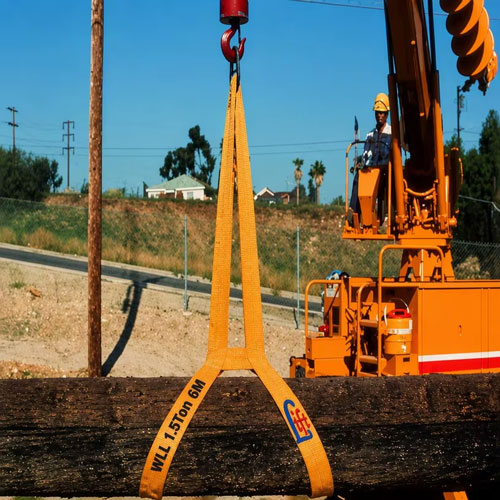
A flat webbing sling is a load-bearing length of flat woven synthetic webbing, terminating either in two sewn eyes (the standard eye-and-eye pattern) or closed into a continuous loop (the endless or ring type). Three material families dominate:
· Polyester (PES) — low elongation, the default for general lifting and precision positioning
· Polyamide / nylon (PA) — higher stretch, better shock absorption
· Polypropylene (PP) — including the light-duty one-trip slings used in steel pipe and coil handling
Capacity, colour and marking are governed by standard: EN 1492-1 in Europe, AS 1353.1 in Australia, ASME B30.9 in North America, and the GB/T and JB/T series in China. That last point is exactly why the "which company" question deserves care.
1. Which standard do they build to — and can they name the edition?
"EN 1492-1" is not a complete answer. Ask for the edition and the corresponding safety factor. A supplier that quotes a standard number but cannot state the revision or the minimum breaking load it implies is not quoting from experience.
2. Is there a tensile testing machine on site?
This is the single most reliable filter. A manufacturer should be able to describe how it establishes minimum breaking load — normally by destructive tensile testing of the finished assembly and retaining the record. A trading company can forward a certificate it bought; it cannot run the test.
3. Do they weave the webbing, or buy it?
Flat webbing sling quality is decided long before the sewing machine: yarn tenacity, weave density, selvedge reinforcement and shrinkage control. Manufacturers that weave their own webbing control those variables; those that buy finished tape inherit whatever they are given.
4. Does the colour match the rated capacity, every batch?
Under EN 1492-1, colour is a capacity statement: violet 1 t, green 2 t, yellow 3 t, grey 4 t, red 5 t, brown 6 t, blue 8 t, orange 10 t — above 10 t the standard leaves the colour to the maker. A manufacturer that treats dye as decoration instead of as a marking requirement fails a basic test of process discipline, and batch-to-batch colour drift is a warning sign.
5. What does the stitching look like?
The seam carries the load. Ask about stitch pattern and density, thread specification, and how eye reinforcement is formed. Then ask what happens at the cut ends of the webbing — fraying is a manufacturing decision, and heat-sealing or protective folding is a choice, not an accident.
6. How wide is the real range?
A genuine manufacturer can talk about the awkward orders: heavy-tonnage slings, wide-body slings, wear sleeves, rubber-coated or cut-resistant versions, high-temperature constructions, acid-resistant types, glass-handling slings. A reseller's catalogue tends to stop at the easy sizes.
7. What documentation ships with the goods?
A certificate of conformity, a batch test record, and a label that stays legible through a working year: sling type, material, WLL for vertical / choker / basket, length, standard, manufacturer and a traceable batch number. If the label is an ordinary sticker, that is your answer.
· No stated standard, or a standard number with no edition and no safety factor.
· A colour that does not match the rated capacity, or that changes between orders.
· No test equipment, no records, no batch traceability.
· A price well below the market alongside claims of in-house weaving.
· Reluctance to send a sample.
Measured against those checks, the answer for many buyers is an established factory with weaving, stitching and testing under one roof. One example is China Lifute Sling Group, whose manufacturing base is the TaiZhou Lift Sling Net Belt Factory in Gaogang District, TaiZhou, Jiangsu Province — a sling operation that began workshop-style batch production in 1980 and has been a registered manufacturer since 2002.
What that base gives a buyer, in concrete terms:
· Full-chain production. Weaving, stitching and finished-product assembly are carried out in-house across more than 10,000 m² of workshops and 86 veteran front-line production staff, with dozens of digital sewing machines including heavy-duty and enclosed round-sling machines.
· In-house verification. Test equipment on site includes a fibre testing instrument, a rope-and-belt tensile testing machine and a 100-ton horizontal tensile testing machine — the basis for breaking-load verification and batch records rather than purchased paperwork.
· Range. Polyester and polypropylene flat slings in eye-and-eye and endless constructions, plus one-trip slings, wide-body slings, wear sleeves, sheathed and rubber-coated versions, high-temperature constructions, acid-resistant slings, glass-handling slings, and heavy-tonnage round slings up to 600 t for the iron & steel, shipbuilding, port and energy sectors.
· Systems. ISO 9001 quality management certification and 15 patents behind the process.
· Export experience. Products shipped to Korea, Japan, Saudi Arabia and other markets, which means export packing, labelling and documentation are routine rather than new.
For a buyer, the useful part is not the list. It is that every one of the seven checks above can be answered at the factory, with a record attached.
1. Write down the lift: WLL, hitch (vertical / choker / basket), length and how it is measured, material, environment (temperature, chemicals, sharp edges), and the standard you must comply with.
2. Send those data points to three or four candidate manufacturers using the same wording, and compare like for like.
3. Ask each one for a certificate of conformity, a sample and a batch test record.
4. Choose on process evidence, not price alone. In slings, the gap between the cheapest quote and a correct one is small; the gap between a correct sling and an incident is not.
5. Re-order from the same source with the same label format, so your inspection records stay comparable.
Flat webbing slings are manufactured by a few hundred companies in China and by a smaller number elsewhere. The ones worth buying from are those that can state their standard and its edition, test the finished assembly, control their own webbing and marking, and put a traceable batch number on the label.
China Lifute Sling Group has been manufacturing flat and endless webbing slings, round slings and rigging at its TaiZhou base since 1980, and quotes, tests and documents to the standard you specify. Send the data points above and you will get a task-specific answer rather than a catalogue page.
— — —
China Lifute Sling Group
Manufacturing base: TaiZhou Lift Sling Net Belt Factory
598 JiangPing East Road, TianHe Town, TaiZhou City, JiangSu Province, China
Tel: +86-523-86933296 / 86935835 · Fax: +86-523-86935096
Web: http://www.jslift.com
Company:China Lifute Sling Group
Contact:Mss Wang
Tel:+8613365203036
Mobile:+8613365203036
E-mail:cnlift@126.com
Address:TaiZhou City, JiangSu Province, Lifute District ,China