语言选择:



Why Choose Endless Webbing Sling?
A practical guide for riggers, lifting-plan engineers and procurement teams
— — —
A lifting sling is usually the cheapest item in a lifting plan and one of the most consequential. When something goes wrong at the hook, it is rarely the crane that is blamed. So the question "which sling?" is not a small one — and among the answers, the endless webbing sling has quietly become the default choice on a growing number of sites.
Why? Not because it is fashionable, but because a continuous loop solves four problems that sewn-eye and metal-fitted slings keep running into.
In the trade, "endless sling" is used for two quite different products:
· Endless round sling — high-tenacity yarn wound into a continuous loop and encased in a woven tubular cover.
· Endless webbing sling (ring sling) — flat woven webbing, closed into a continuous loop with no eyes and no metal fittings.
Both are "endless" in shape, but they behave differently under load, are rated differently, and are inspected differently. When you specify one, describe the construction rather than relying on the name: flat woven webbing, continuous loop, no end fittings. It avoids a costly misunderstanding at the quotation stage.
1. No stress concentration at a sewn eye.
On a conventional eye-and-eye flat sling, the stitching is the point where stress concentrates and, statistically, where failures and rejections originate. A continuous loop distributes that load around the whole circumference — there is no single sewn termination to watch.
2. Nothing metal touches the load.
No shackle body, no hook-to-eye contact, no swage. On polished steel, coated pipe, stainless sheet, glass and finished machined parts, this is not a luxury — it is the difference between a delivered product and a rejected one.
3. Wear is distributed and reversible.
Because the loop has no fixed "top", it can be rotated between lifts. Wear spreads over the full length instead of concentrating at same two eyes — in practice this is one of the simplest ways to extend service life at zero cost.
4. Pressure is spread across a wide contact area.
Flat webbing presents far more surface than wire rope or chain. On soft or thin-walled loads — coils, tubes, GRP sections, extruded profiles — a wider contact patch means lower local surface pressure and less deformation. Combined with an optional wear sleeve, this is why endless webbing slings are standard in glass handling and in lifting of painted or plated components.
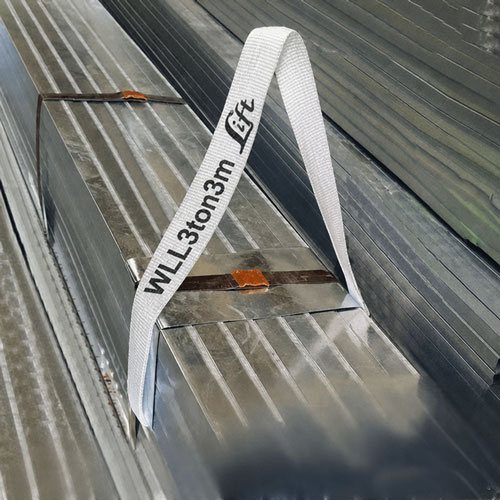
The shape is only half the story. Capacity is not a property of the sling alone — it depends on how you rig it.
Mode factor (single sling):
Hitch | Mode factor | Effect on a 5 t sling |
Vertical | 1.0 | 5 t |
Choker | 0.8 | 4 t |
Basket (0° included angle) | 2.0 | 10 t |
Safety factor.
Under EN 1492-1 the minimum breaking load is seven times the WLL (7:1). Under ASME B30.9 the factor is 5:1. The same physical sling can therefore carry two different declared working load limits depending on which standard it was made and marked to. The number you see on the label is meaningless unless you also know the standard behind it.
Colour code (EN 1492-1). The colour is not decoration — it is a capacity statement that must survive every shift, every wash and every inspection:
Colour | WLL |
Violet / Purple | 1 t |
Green | 2 t |
Yellow | 3 t |
Grey | 4 t |
Red | 5 t |
Brown | 6 t |
Blue | 8 t |
Orange | 10 t |
Above 10 t the standard leaves the colour to the manufacturer, which is exactly why heavy-tonnage slings must be identified by their label and documentation rather than by eye.
Temperature. The standard working range for polyester and polyamide webbing slings is approximately −40 °C to +100 °C. Beyond that, capacity must be de-rated, and for genuinely hot work — ladles, ingots, hot castings — a purpose-made high-temperature sling is required. This is a hard boundary, not a guideline.
Both are synthetic webbing; they fail differently.
· Polyester (PES) — low elongation, roughly 3% at WLL. Loads stay where you put them, bounce is minimal, precision positioning is easier. Good resistance to most acids; poor against strong alkalis.
· Polyamide / nylon (PA) — noticeably higher stretch at WLL, which absorbs shock and makes it more forgiving on dynamic or uneven lifts. But it is the more acid-sensitive of the two.
If your load is delicate and your crane control is good, polyester. If the lift is likely to snatch or the load is hard to balance, nylon. Both resist rot and mildew; both are degraded by UV, which is a storage and inspection issue rather than a material choice issue.
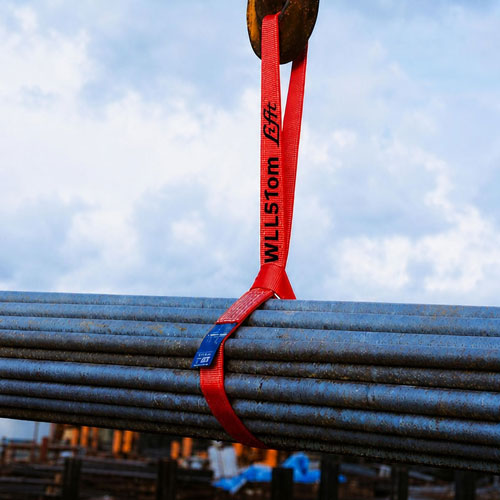
Credibility comes from saying this out loud.
· Sharp edges. Cut edges destroy webbing. Without a sleeve, protector or corner radius, choose a different sling type or add protection.
· Heat. Above the rated range, de-rate or change product family.
· Chemicals. Strong alkalis (polyester) and strong acids (nylon) attack the fibre; the damage is often invisible until the sling breaks.
· Abrasion. Dragging a sling across concrete or over the load shortens its life faster than any other single habit.
· Permanent installation outdoors. UV and weathering degrade synthetic webbing; a sling is lifting equipment, not a fixture.
Two identical slings, one lasting three months and one lasting three years, are usually separated by handling, not by manufacturing. A workable discipline looks like this:
· Check before every use: cuts, edge damage, abrasion, pulled or glazed yarn, chemical staining, heat glazing, damaged or illegible label.
· Never drag a sling out from under a load.
· Rotate the loop between lifts so wear is even.
· Keep records so that "how old is this sling?" is an answerable question.
· Store dry, off the floor, out of direct sun.
Give the manufacturer these seven items and there is very little left to go wrong:
1. Working load limit, and the hitch it will be used in
2. Material — polyester or nylon
3. Length, and how it is measured (loop circumference or laid-flat length; published tolerances have tightened in recent standard revisions)
4. Relevant standard — EN 1492-1, AS 1353.1, ASME B30.9 or another
5. Protection — sleeve, wear pad, edge reinforcement
6. Temperature and chemical environment
7. Label and traceability requirement (batch, test certificate, tag)
At the sling level, three things separate suppliers:
· The webbing itself — yarn quality, weave density and edge reinforcement. Dye consistency matters more than buyers expect, because a sling whose colour does not match its rated capacity is a documentation failure with safety consequences.
· The joint and finish — even a ring sling has a closure or overlap zone; that area is where process discipline is visible.
· Proof of capacity — tensile testing to breaking, batch-linked records, and the willingness to show the certificate.
This is the part of the answer that belongs to Lift Sling Net Belt Group. The group manufactures throughout the full chain, from fibre weaving and stitching to finished-product assembly, at its base in Gaogang District, TaiZhou, Jiangsu — a lifting-sling workshop that began batch production in 1980 and has been a registered manufacturer since 2002. Its 10,000 m² of workshops and 86 production staff are supported by in-house testing that includes a fibre testing instrument, a rope-and-belt tensile testing machine and a 100-ton horizontal tensile testing machine; the company holds ISO 9001 certification and 15 patents, and its sling range runs from one-trip and ring slings through high-temperature and acid-resistant types to heavy-tonnage round slings up to 600 t for the iron & steel, shipbuilding, port and energy sectors. Products are exported to Korea, Japan, Saudi Arabia and further markets.
For a buyer, the useful takeaway is not the specification list — it is that the questions above can be answered at the factory gate, with a certificate, rather than by email after an incident.
Choose it when the load must not be marked. When the lift needs a sling that can be rotated, folded and reused rather than made up on site. When the surface pressure matters as much as the tonnage. When the same sling has to work in a basket one minute and a choker the next.
And choose it with the same rigour you would apply to any other piece of lifting equipment: the right capacity for the hitch, the right material for the environment, a legible label, and a documented inspection routine. The loop is the easy part. The discipline around it is what keeps it safe.
— — —
Lift Sling Net Belt Group — TaiZhou Lift Sling Net Belt Factory
598 JiangPing East Road, TianHe Town, TaiZhou City, JiangSu Province, China
Tel: +86-523-86933296 / 86935835 · Fax: +86-523-86935096
Web: http://www.jslift.com
公 司:China Lifute Sling Group
联系人:Mss Wang
电话:+8613365203036
手机:+8613365203036
E-mail:cnlift@126.com
地 址:TaiZhou City, JiangSu Province, Lifute District ,China