语言选择: 



An industry perspective on how construction method — not just fibre — decides whether your counter-drone barrier works when it matters most.
Rogue drones have become a routine operational problem. Airports face airspace incursions that halt departures. Prisons receive contraband drops over perimeter walls. Military sites and critical infrastructure are probed daily by small, cheap, off-the-shelf UAVs that no radar can reliably classify and no jammer can always stop.
That is why passive netting has become the default answer for so many security managers. A net never runs out of battery, never triggers false positives, and never stops working because someone forgot to update firmware. It is simply there, every hour of every day.
But here is the question that rarely gets asked until it is too late: once a drone actually hits the net, does the net hold?
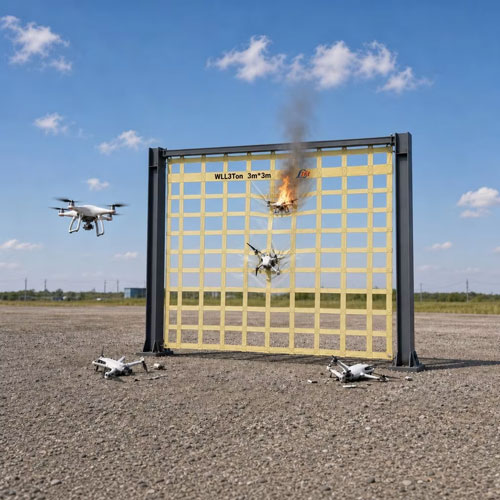
Aramid — the family of para-aramid fibres that includes Kevlar and its equivalents — is chosen for one reason: an exceptional strength-to-weight ratio that outperforms steel on a per-weight basis. The fibre is the raw material of every aramid net on the market.
The fibre, however, is not the net. Aramid only protects you to the extent that the construction method lets it work. And when you compare the two mainstream aramid net constructions available today — knotted rope nets and sewn webbing nets — the difference at the moment of impact is dramatic.
In a knotted rope net, the aramid is first braided or twisted into rope, then the rope is tied into a mesh. The defining feature of this construction is that the fibre runs continuously through every knot.
This matters more than it sounds. When the net is struck, the impact load travels along the entire rope and is locked at each knot, with the full bundle of filaments bearing the load continuously — nothing is cut, nothing is broken mid-span. The knot is, in effect, the net's load-bearing heart, and it is this continuous-filament transfer that lets a knotted aramid rope net demonstrate the fibre's full strength.
The practical benefits follow naturally: rope nets are light, flexible, easy to roll up, and quick to deploy over large areas. For temporary or mobile protection, they remain a very capable option.
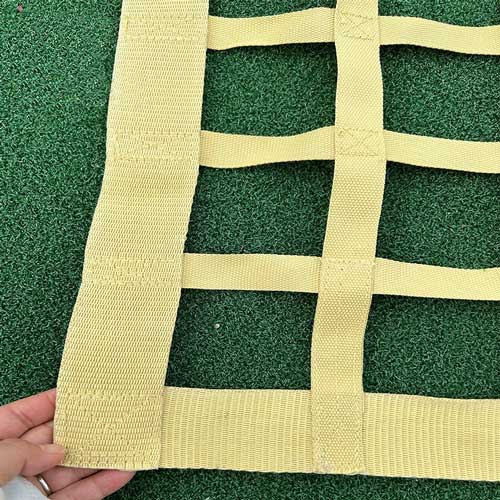
The sewn webbing net takes a different path. Here, flat aramid webbing — a woven, high-tenacity structure in its own right — is laid out in a grid and the intersections are locked with high-strength industrial sewing. The result is a net whose geometry is rigid, not elastic.
And that rigidity is the point. Two things happen with this construction that rope nets cannot match:
First, the strength of the webbing itself is on full display. Flat webbing is a dense woven structure that distributes load across its full width. What you see on the net is what carries the load — no hidden weak points, no reliance on a single knot.
Second, and decisively: the mesh openings do not enlarge or shift under load. This is the difference that changes outcomes. In a rope net, impact force causes the knots to slide and the rope to stretch, so the openings between the meshes enlarge and migrate under tension. A striking drone can push the mesh apart, squeeze through an opening that has grown, or drag the net into a deep bag that lets it keep flying underneath. The barrier becomes a suggestion rather than a wall.
A sewn webbing net holds its nominal mesh size under tension. Because the webbing intersections are sewn rigid and the webbing itself has low elongation, the openings stay essentially fixed at the moment of impact. The drone is caught where it hits — not funneled toward a gap that has just opened up. For any site where "every incursion must be stopped, every time" is the requirement, this mesh stability is the single most valuable property a net can have.
Criterion | Knotted Aramid Rope Net | Sewn Aramid Webbing Net |
Fibre strength utilization | Continuous filaments locked at knots | Full-width woven webbing strength |
Mesh geometry under load | Openings enlarge and shift under tension | Openings hold nominal size — no expansion, no migration |
Penetration resistance | Depends on knot quality and rope diameter | Rigid grid + webbing width; consistently resists squeezing-through |
Weight & handling | Light, flexible, rolls up easily | Slightly heavier, stiffer, holds its shape |
Coverage & visibility | More open, more transparent | Denser coverage per square metre |
Best deployment | Large-area, temporary, mobile | Permanent perimeter protection with high intercept certainty |
There is no single "best" net — only the right net for the threat profile and the operating reality of your site.
• Airports and airspace-restricted zones — the requirement is intercept certainty during every approach and departure. The webbing net's stable mesh means a struck drone cannot enlarge the opening and push through, or drag the barrier down around it. Choose sewn webbing.
• Prisons and secure perimeters — round-the-clock protection against both aerial drops and climbing attempts. The denser, rigid webbing grid also deters tampering and cutting more effectively. Choose sewn webbing.
• Military and field operations — rapid, temporary coverage over large areas, where portability and quick deployment outweigh long-term rigidity. The knotted rope net's light weight and rollability are genuine advantages. Choose knotted rope.
• Critical infrastructure and long-term installations — a fixed barrier that must perform identically in year one and year five. Mesh stability and structural integrity over time favour the sewn webbing construction.
Aramid sets the ceiling — the fibre is world-class in every net. The construction method decides the actual performance. If your security plan says "every intrusion must be intercepted," mesh stability is the decisive factor, and that is exactly where the sewn aramid webbing net is built to win: full webbing strength on display, and a grid that does not move when the drone hits it.
The fastest way to settle the question is not a brochure — it is a sample. Put both constructions on your own perimeter, hit them the way a real drone would, and read the mesh after impact. We will gladly provide comparison samples, technical data sheets, and an engineer's assessment of your site layout.
Talk to an engineer about your site — request samples and a free protection assessment.
WhatsApp: +86 1336 520 3036 | E-mail: cnlift@126.com
Company:China Lifute Sling Group
Contact:Mss Wang
Tel:+8613365203036
Mobile:+8613365203036
E-mail:cnlift@126.com
Address:TaiZhou City, JiangSu Province, Lifute District ,China