语言选择: 



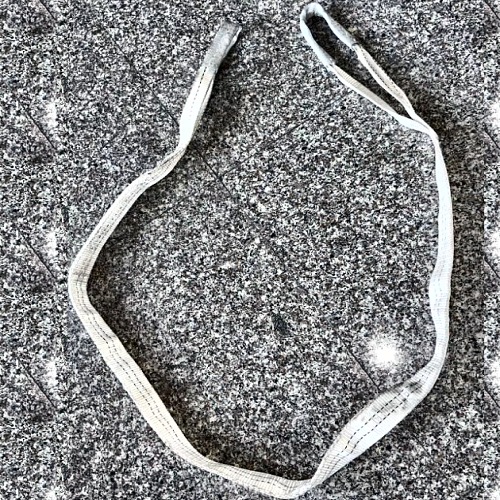
China Lifute Sling Group manufacture 2000KG Single Use Lifting Sling,SWL 2,000kg Endless one way sling,2 Tonne Lifting Sling,2,000kg / 2 tonne duplex Webbing Sling,2000kg Round/Endless Durable Lifting Sling,2 Tonne Single Use Sling,2000kg Green Flat Lifting Strap.
2,000 kg Green Endless One-Way Webbing Sling — 50 mm Polyester, 7:1, Single Trip
Quick answer. a 2000KG single use lifting sling is a one-trip polyester webbing sling with a working load limit of 2,000 kg (2 t) per leg in a vertical hitch. It is colour-coded green to EN 1492-1, sewn from 50 mm two-ply high-tenacity polyester webbing, proof tested to 4,000 kg and built to a 7:1 design factor (minimum breaking load 14,000 kg). Standard build: endless loop, 0.5–6 m effective length; eye-and-eye and choked versions on request. The sling is lifted once, inspected immediately before that lift, then withdrawn and destroyed.
China Lifute Sling Group manufactures the 2000KG single use lifting sling — a green, 2 tonne one-way webbing sling built for one lift and then retirement. Each sling is sewn from 50 mm two-ply high-tenacity polyester (PES) webbing, rated at a 2,000 kg working load limit in a vertical single-leg hitch, proof tested to 4,000 kg, and produced to a 7:1 design factor, giving a minimum breaking load of 14,000 kg. Green is the EN 1492-1 colour code for 2,000 kg, so the capacity can be read from across a loading bay, a container floor or a precast yard without unrolling the sling to find the label.
Because a one-way sling is never meant to come back, it removes the two costs that dominate reusable slings on project work: return freight and the periodic thorough-examination register. It ships flat, fills the gaps around a machine in a container, and can be cut and discarded at the destination instead of being cleaned, stored and shipped home. That is why single-trip slings are the default choice for export packing, steel pipe bundles, precast panels and one-off heavy lifts where the hook goes up once and the sling has no second job.
The 2000KG single use lifting sling sits at the working end of our one way sling range, where capacity, colour and label are read at a glance. The number is a rating, not a guess. 2,000 kg is the working load limit (WLL) — the maximum load the sling may carry in a single vertical leg with the load under control. It is not a breaking strength, and it is not a licence to lift 2 tonnes at any angle. At 45–60° from the vertical the same leg is rated 1,400 kg, and in a two-leg hitch the assembly rating depends on the included angle (see the multi-leg table in section 3).
"Single use" describes the service life, not the construction. The webbing, stitching and proof test are the same as a reusable 2 tonne sling; the difference is that this sling is designed, labelled and priced for one lift. Once that lift is complete the sling is withdrawn from service and destroyed, so no inspection register, no storage and no return freight are carried by the buyer. The single-trip label is a documented decision: it tells a site inspector that the sling has no history to verify and must not be re-issued.
Practically, the WLL is marked on a sewn label together with the effective length, the material, the batch number, the date of manufacture and the CE mark. If the label is missing, illegible or shows a different capacity, the sling is not a 2000KG sling and must not be used.
The sling is built around one continuous length of 50 mm two-ply polyester webbing, joined into an endless loop with a multi-row lock stitch in high-tenacity filament thread. Polyester is chosen for three reasons: it has low elongation under load (typically 3% or less at WLL), it does not absorb water or rot like natural fibre, and it is soft enough to sit against painted, galvanised or machined surfaces without marking them.
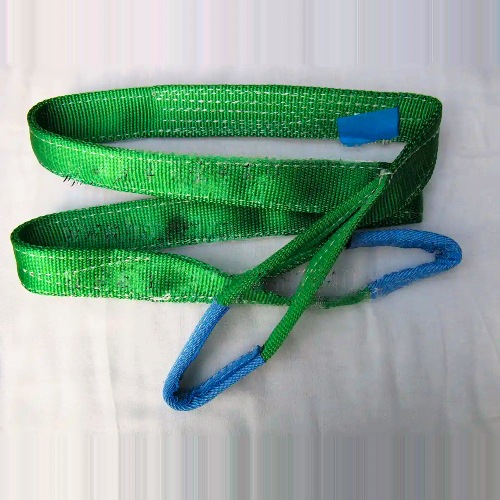
Webbing: 100% high-tenacity polyester (PES), two-ply, 50 mm standard width; 60 mm and 75 mm on request.
Loop: endless (one-way) loop as standard, formed by a reinforced sewn join — no metal fittings, no hooks, nothing to scratch a load.
Stitching: multi-row lock stitch in matched polyester thread, with the join positioned away from the load-bearing face of the loop.
Label: printed textile label with WLL, effective length, material, CE mark, batch number and date of manufacture; customer logo and serial numbering available.
Finish: heat-sealed or over-locked edges to limit fraying; no hard edges anywhere on the sling body.
Inspection: every batch proof tested to 2 × WLL (4,000 kg) and visually checked over its full length before packing.
Use the table below to confirm the build before ordering. The parameters are the ones that change the price and the rating; anything not listed can be quoted to your drawing.
| Parameter | Specification |
|---|---|
| Model | LF-OWS-2000 (endless) / LF-OWS-2000-EE (eye and eye) |
| Working load limit (WLL) | 2,000 kg / 2 t — single leg, vertical hitch |
| Colour code | Green — EN 1492-1 code for 2,000 kg |
| Webbing | 100% high-tenacity polyester (PES), two-ply |
| Web width | 50 mm (2 in) standard; 60 mm / 75 mm available |
| Effective length (EWL) | 0.5 – 6.0 m, ±2%; custom lengths to drawing |
| Loop / end type | Endless loop standard; eye and eye, choked, reverse eye on request |
| Design factor | 7:1 — minimum breaking load 14,000 kg |
| Proof test | 4,000 kg (2 × WLL), every batch |
| Elongation at WLL | ≤ 3% |
| WLL at 45–60° (single leg) | 1,400 kg |
| Operating temperature | −40 °C to +100 °C |
| Label / marking | WLL, EWL, material, CE, batch no., date of manufacture; logo and serial on request |
| Unit weight | ≈ 0.32 kg per metre at 50 mm width |
| Packing | 25 or 50 pcs per export carton, palletised and strapped |
| HS classification | 5609.00 (confirm with your customs broker) |
Table 1 — single-leg parameters. Minimum breaking load from the 7:1 design factor; proof test 2 × WLL.
Table 1 — single-leg parameters. Minimum breaking load is derived from the 7:1 design factor; proof test is 2 × WLL. Working load limits apply to a straight, vertical lift with the load balanced and the sling free of knots, twists and edge contact.
Most buyers do not lift with a single vertical leg. The assembly rating is the leg WLL multiplied by the mode factor for the number of legs and the angle to the vertical:
| Sling configuration | Angle to vertical | Mode factor | Assembly WLL |
|---|---|---|---|
| 1 leg | 0–45° | 1.0 | 2,000 kg |
| 1 leg | 45–60° | 0.7 | 1,400 kg |
| 2 legs | 0–45° | 1.4 | 2,800 kg |
| 2 legs | 45–60° | 1.0 | 2,000 kg |
| 3 or 4 legs | 0–45° | 2.1 | 4,200 kg |
| 3 or 4 legs | 45–60° | 1.5 | 3,000 kg |
Table 2 — assembly ratings from a 2,000 kg leg WLL. The weakest leg governs; loads must be symmetric.
Table 2 — assembly ratings derived from a 2,000 kg leg WLL. The weakest leg governs, loads must be symmetric, and the centre of gravity must sit below the hook. For asymmetric or multi-point lifts, ask us to calculate the rating for your load.
The 2000KG rating stays fixed; the shape around it does not. The common variants we build for export and project work:
Endless one-way loop — the standard single-use format, cheapest per lift, and the easiest to choke around a bundle.
Eye and eye — two flat eyes for shackles or hooks; see the eye and eye single use sling range for dimensions.
Choked / choker — a loop passed around the load and back through itself, with the choked WLL reduced to 0.8 × the vertical rating.
Reverse eye and tapered eye — for pulling and for tight bundling where the eye must lie flat.
Widths from 50 mm to 75 mm — a wider web spreads pressure on soft or finished surfaces.
Colour and print — green is standard for 2,000 kg; other colours are produced on request but must never be used to imply a different capacity.
Labelling — customer logo, project number, QR code or serial number printed on the label for site traceability.
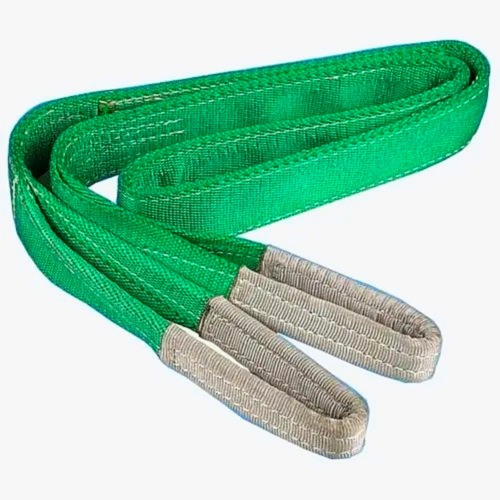

Steel pipe and tube bundles — soft webbing will not nick the pipe wall; see one way lifting sling for steel and steel tube for the pipe-specific build.
Export packing and container stuffing — the sling goes into the box or the container with the goods and never comes back; see polyester export packing one way sling.
Precast concrete panels and blocks — the loop is cast-in or passed through lifting inserts and cut off after erection.
One-off machinery moves and plant relocations — where a reusable sling would have to be bought, logged and then stored.
Shipyards, fabrication shops and wind-tower works — heavy sub-assemblies lifted once into position.
Rental and hire fleets — a sling that leaves with the equipment and is not chased afterwards.
Where the lift repeats every day, a reusable sling is cheaper over its life — compare the two builds on our webbing sling page, or step up to a round sling if the load has soft or awkward geometry. For light export bundling at 1 tonne, the 1 ton white one way webbing sling covers the same job with a smaller web.
The purchase price of a one-trip sling is lower, but the real difference is the cost that sits around the sling: freight back, storage, inspection time and paperwork. The table below is the decision most buyers actually face.
| Factor | 2000 kg single use | 2 t reusable webbing sling |
|---|---|---|
| Design factor / strength | 7:1, 14,000 kg minimum breaking | 7:1, same webbing and stitching |
| Service life | One documented lift | Multi-year, subject to inspection |
| Inspection | Visual check before the single lift | Pre-use check plus periodic thorough examination |
| Paperwork | Batch certificate only | Individual register, serial numbers |
| Return logistics | None — left at destination or destroyed | Return freight, cleaning and storage |
| Best fit | Export packing, one-off heavy lifts, project sites | Daily production, hire fleets, repeat lifts |
Rule of thumb: if the sling would have to travel back more than once, or sit in a warehouse waiting for a thorough examination, the single-use build usually wins even at a higher unit price. If the same sling will make fifty lifts a week on one production line, buy reusable.
Load weight and centre of gravity — the true load, not the crane's capacity.
Number of legs and the angle to the vertical — this sets the assembly rating, not the leg rating.
Effective length (EWL) — measured loop-to-loop or eye-to-eye, in metres, with the tolerance you will accept.
Loop type — endless, eye and eye, choked, reverse eye.
Quantity, label content and packing — carton count per pallet, logo, serial numbers, and whether the slings ship with the goods.
Send those five lines with the destination port and we will confirm the build, the label wording and the packing before production. If you are unsure of the angle factor, send a sketch of the lift and we will calculate the rating for you.
A single-use sling gets one chance, so the pre-lift check matters more than it does on a reusable sling that will be examined again next month. Two minutes on the dock:
Read the label: WLL 2,000 kg, length matching the lift plan, batch and date legible.
Run the full length through your hands: cuts, abrasion, welding spatter burns, chemical staining, or a stitch line that has started to pull.
Check the loop join for broken or slack stitching and for thread that has been cut by an edge.
Reject any sling with a damaged label — an unreadable rating is an unrated sling.
Protect sharp edges with corner protectors or packing; a single-use sling is not a wear part and will not survive a cut edge.
Keep the sling clear of hot work; polyester is rated −40 °C to +100 °C and must not be used near flame or molten metal.
After the lift, cut the sling through the loop and discard it. Cutting is deliberate: it prevents an unrecorded second use by someone who finds the sling in the back of a truck.
Every sling carries a sewn label with the WLL, effective length, material, CE mark, batch number and date of manufacture, plus the manufacturer's name. Labels are printed to survive a sea freight cycle and stay legible through the lift.
Slings are packed flat in export cartons — typically 25 or 50 pieces per carton, palletised and strapped — with the carton marked with the product name, quantity, batch and gross weight. A certificate of conformity, the proof-test record for the batch and a packing list are issued with the shipment; material and test certificates can be added on request. Typical HS classification for polyester webbing slings is 5609.00, to be confirmed with your customs broker against the final description.
It is the working load limit: 2,000 kg in a single vertical leg. The minimum breaking load is 14,000 kg at a 7:1 design factor, and the leg is rated 1,400 kg at 45–60° from the vertical. It is a capacity, not a breaking strength, and it is not cumulative.
No. The webbing, stitching and 7:1 design factor are the same. What changes is the service life and the inspection regime: the one-trip sling is labelled for a single lift, so it is not entered into a periodic examination register.
Green is the EN 1492-1 colour code for a 2,000 kg working load limit, following the sequence violet 1 t, green 2 t, yellow 3 t, grey 4 t, red 5 t, brown 6 t, blue 8 t and orange 10 t. The colour lets a banksman identify the capacity before reading the label.
It is designed and labelled for one lift. A second lift falls outside the stated rating and outside the manufacturer's liability, and the sling has no inspection history to support it. If you need repeat lifts, specify a reusable sling with a serial number and register.
Order by effective length (EWL) — the working length between the inside of one loop and the inside of the other, measured flat and unloaded. State the tolerance you need; ±2% is standard. For a choked lift, add the circumference of the load to the length you need under the hook.
At 2,000 kg per leg with two legs at 0–45°, the assembly is rated 2,800 kg — not enough for 3,000 kg. Either reduce the angle below 45° with a wider spreader, use four legs at 0–45° (4,200 kg assembly), or move to a 3 tonne or 4 tonne sling. Never rely on the sum of the leg ratings without the mode factor.
No — polyester webbing is soft and non-marring, unlike chain or wire rope. It will still be cut by a sharp edge, so use edge protectors on plate, profiles and machined corners.
Polyester is rated from −40 °C to +100 °C. Above 100 °C the fibre loses strength quickly; for hot work use an aramid sling instead. Molten metal splash and welding spatter are never acceptable, even briefly.
Yes. We print customer logos, project codes, QR codes and serial numbers on the sewn label, and can match your carton marking and packing list format.
Send the load weight, number of legs and angle, effective length, loop type and quantity, and we will confirm the build, the label and the packing before production. Standard 2,000 kg single use slings ship from Taizhou, Jiangsu; custom labels and widths are produced to order.
China Lifute Sling Group · Tel / WhatsApp +86 133 6520 3036 · cnlift@126.com · Taizhou City, Jiangsu Province, China
Company:China Lifute Sling Group
Contact:Mss Wang
Tel:+8613365203036
Mobile:+8613365203036
E-mail:cnlift@126.com
Address:TaiZhou City, JiangSu Province, Lifute District ,China



