4 Ply Webbing Sling
China Lifute Sling Group manufactures 4 ply webbing slings to EN 1492-1 — four layers of high-tenacity polyester webbing stitched into one flat sling, so the same working load limit arrives in a narrower, longer-wearing webbing than a two-ply build. Standard capacities 1 t to 12 t, heavier on request. Colour-coded to the standard, batch-tested on a 100-ton horizontal tensile testing machine, and supplied with a traceable label and test certificate.
If your lift is abrasive, your hook opening is small, or your slings simply wear out too fast, ply count is usually the variable that fixes it — not a bigger tonnage.
Need a quote? Tell us the working load limit, the ply count, the standard, the length, the hitch and the working environment — we will quote against your requirement rather than a catalogue page.
What “4 ply” actually means
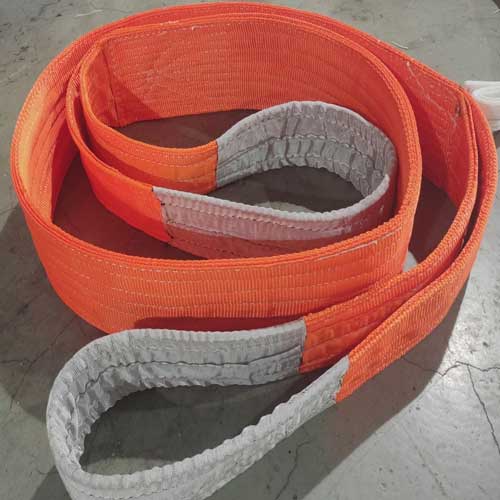
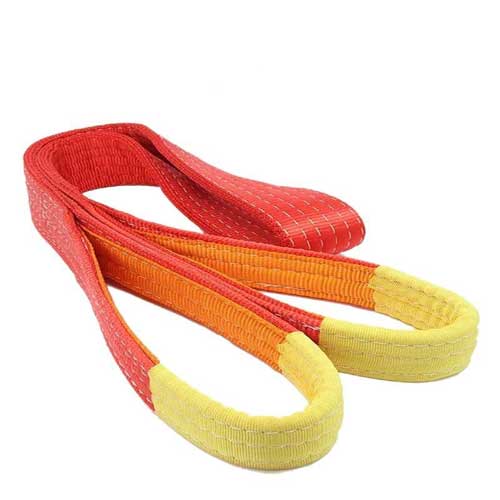
A 4 ply webbing sling is built from four separate layers of flat woven webbing, laid one on top of another and stitched together into a single flat body, with the eyes formed at both ends. The layers are not a cosmetic feature: each one carries load, and each one has to be worn through before the sling fails.
Because four layers share the load:
the same WLL can be delivered in a narrower webbing, which fits smaller hooks, shackles and gaps;
there is roughly four times as much material to abrade compared with a single-layer sling of the same webbing, which is what extends service life in gritty, wet or rough-handling conditions.
A note on naming, because it trips up cross-border buying. Ply counting is not harmonised internationally. What is consistent is the physics: four layers carry roughly four times the breaking load of one layer of the same webbing. So a 4 ply sling is either stronger than a 2 ply at the same width, or the same strength in a narrower width — depending on which variable the maker held constant. State the WLL, the width and the ply you need, and the ambiguity disappears.
The trade-off that decides the build
Every flat woven sling is a compromise between three variables: WLL, width and ply count. Fix any two and the third follows.
| You need | Choose |
|---|---|
| A given WLL through a narrow opening | More plies, narrower webbing |
| A given WLL with maximum flexibility | Fewer plies, wider webbing |
| A given width and the highest possible WLL | More plies |
| The longest life in abrasive conditions | More plies, plus wear sleeves at the contact points |
This is why a 4 ply sling is not simply “a stronger sling”. It is the right answer to a specific set of conditions — narrow access, abrasive load, long service interval — and the wrong answer to others.
Ply options
| Ply count | Also called | Character | Typical use |
|---|---|---|---|
| 1 ply | Simplex, single layer | Thinnest and most flexible; widest webbing for a given WLL | Light duty, tight wraps, delicate surfaces |
| 2 ply | Duplex | The general-purpose standard build | Most lifting duties — the default |
| 3 ply | Triplex | Narrower and stiffer, with more wear material | Abrasive duty, confined hardware |
| 4 ply | Quadraplex, four-layer | Narrowest webbing for a given WLL; maximum wear material; stiffest | Abrasive and heavy duty, small hook openings, long service life |
Terminology varies by market; the standard reference and the label are what count, not the trade name.
Why engineers choose a 4 ply webbing sling
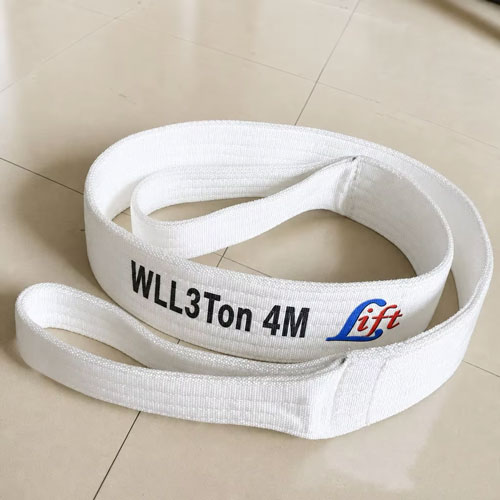
Narrow body, full capacity. Where a 2 ply sling of the same WLL will not pass through a hook throat, a shackle jaw or a gap in the load, the 4 ply build usually will.
Far more abrasion resistance. Four layers must be worn through instead of one. In gritty, wet or rough-handling environments — stone, concrete, foundry, shipyard — this is the difference between a consumable and a durable tool.
Longer service life at the same duty. Multi-ply slings degrade more slowly than single-ply slings, because the outer layer protects the layers beneath it.
Better tolerance of edge contact. More material in the body means an edge or a burr has further to cut before it reaches a load-bearing layer.
The usual webbing advantages. Soft, non-marking, no metal contact against the load, no spark risk, light enough to position by hand.
Capacity still reads at a glance. A 4 ply sling carries the same EN 1492-1 colour code as any other build of the same WLL — the colour states the capacity, not the construction.
When a 4 ply sling is the wrong answer
You need flexibility. Four layers make a stiff body. A tight choke around a small radius, or a wrap through a confined space, is easier with 1 ply or 2 ply.
A very wide 4 ply build stops being practical. Broadly beyond about 150 mm, a multi-ply flat sling becomes heavy and awkward to handle, and a round sling is usually the better tool for the same duty.
Your hardware is the limiting factor. A thicker body changes how the sling sits in a hook or a shackle, and how it bends over a small-diameter load. Check the D/d relationship before assuming the sling is the only variable.
The damage is not abrasion. If the failure mode is chemical, thermal or UV, extra layers do not help — the fibre and the working environment need to change instead.
Working load limit and colour code
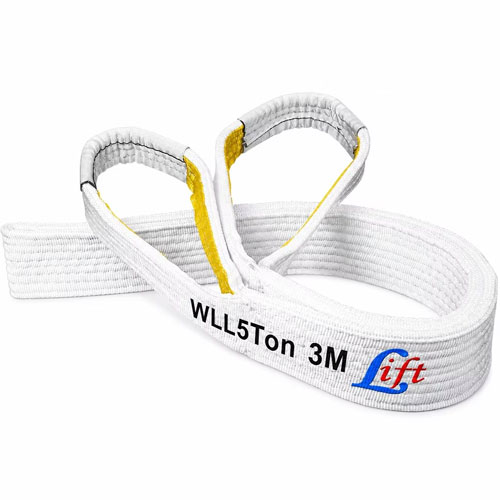
Under EN 1492-1 the webbing colour identifies the WLL for a straight lift, and the number of black transverse stripes repeats the tonnage. Colour is set by the WLL, not by the ply count.
| Webbing colour | Black stripes | Typical width, duplex (2 ply) reference | WLL, straight lift |
|---|---|---|---|
| Violet | 1 | 30 / 50 mm | 1 t |
| Green | 2 | 60 mm | 2 t |
| Yellow | 3 | 90 mm | 3 t |
| Grey | 4 | 120 mm | 4 t |
| Red | 5 | 150 mm | 5 t |
| Brown | 6 | 180 mm | 6 t |
| Blue | 8 | 240 mm | 8 t |
| Orange | 10 | 300 mm | 10 t |
| Orange | 12 | 300 mm | 12 t |
The width column is the duplex reference point. A 4 ply build reaches the same WLL in a narrower webbing — that is the purpose of the construction. Confirm the exact width against the label and the drawing for your order.
Note: EN 1492-1 assigns colours up to 10 t. Above 10 t the colour is left to the manufacturer, which is why 12 t and heavier slings are normally supplied in orange.
Capacity changes with the hitch — mode factors
The published WLL is a vertical (straight) lift figure. Every other arrangement multiplies it by a mode factor.
| Sling arrangement | Mode factor | A 5 t sling gives |
|---|---|---|
| Vertical | 1.0 | 5.0 t |
| Choker | 0.8 | 4.0 t |
| Basket, parts parallel (β = 0°) | 2.0 | 10.0 t |
| Basket, β up to 45° | 1.4 | 7.0 t |
| Basket, β 45–60° | 1.0 | 5.0 t |
| Two-leg, master link angle ≤ 90° | 1.4 | 7.0 t |
| Four-leg, master link angle ≤ 90° | 2.1 | 10.5 t |
Factors multiply — a two-leg assembly at 45° that is also choked gives 1.4 × 0.8 = 1.12. And a four-leg sling is 2.1, not 4.0, because one leg acts largely as a stabiliser in practice.
Materials
The colour of the label — not the colour of the webbing — tells you the fibre.
| Fibre | Label colour | Temperature range | Chemical resistance |
|---|---|---|---|
| Polyester (PES) | Blue | −40 °C to +100 °C | Resists most mineral acids. Attacked by alkalis. |
| Polyamide (PA / nylon) | Green | −40 °C to +100 °C | Immune to alkalis. Attacked by acids. |
| Polypropylene (PP) | Brown | −40 °C to +80 °C | Unaffected by acids or alkalis. Attacked by solvents. |
Polyester is our standard fibre for 4 ply construction: high tenacity, low elongation, good UV and abrasion performance. Polyamide and polypropylene are available where the chemical or temperature duty requires them. High-temperature constructions are available for hot duty — tell us the temperature and the exposure and we will specify the fibre.
Construction options
| Feature | Options |
|---|---|
| Form | Eye-and-eye (two sewn eyes) · Endless / ring (continuous loop, no end fittings) |
| Plies | 1 (simplex) · 2 (duplex) · 3 (triplex) · 4 (four-layer) |
| Eye type | Flat eye · Twisted eye · Reversed eye · Reinforced (protected) eye |
| Protection | Wear sleeves, reinforced eyes and edge protection at contact points |
| Duty | General purpose · Abrasive / heavy duty · One-trip · High-temperature · Acid-resistant · Glass handling |
How length is measured: from bearing point to bearing point, with the sling laid flat. Please state the length on this basis, and confirm whether you mean the length of the sling or the circumference of a ring sling — the two are not the same number.
Standards and conformity
| Standard | Region | Safety factor |
|---|---|---|
| EN 1492-1 | Europe, UK, Middle East, Africa | 7:1 |
| ASME B30.9 | USA, Canada | Commonly 5:1 |
| AS 1353 | Australia, Oceania | Commonly 8:1 |
| JIS B 8818 | Japan | As specified |
EN 1492-1 covers both single- and multi-ply flat woven webbing slings. We manufacture to EN 1492-1 with a 7:1 safety factor as standard and to the other standards on request — please name the standard and the safety factor explicitly on the purchase order. Webbing built to 5:1 or 8:1 is not interchangeable with EN 1492-1 webbing of the same marked capacity.
Marking and traceability
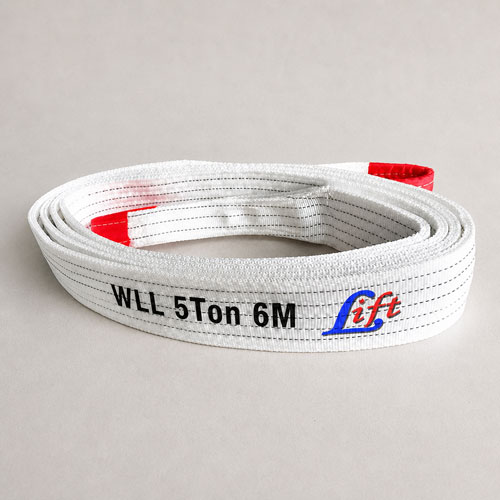
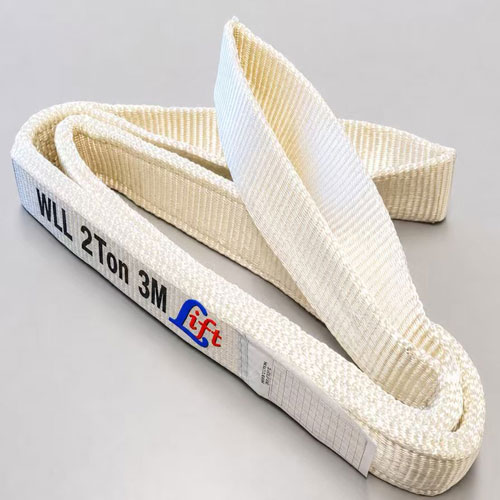
Every sling carries a permanently attached, legible label showing at least the working load limit for a straight lift; the material of the webbing; the standard reference; length, sling type and manufacturer; and a traceability code linking the sling to its production batch and test record. The label is the document that certifies the sling — a sling with a missing or illegible label is out of service.
Where 4 ply webbing slings are used
Stone, concrete and precast panels · steel plate and fabricated sections · pipe and tube handling · foundry and casting · shipbuilding and shipyards · ports and terminals · glass and architectural panels · heavy machinery and plant installation · general fabrication where slings wear out quickly.
Safe use and inspection
Always
Inspect the sling before every use, and again before returning it to store.
Spread the load evenly across the full width of the sling.
Use protective sleeves or packing wherever the webbing meets a sharp edge.
Set the choke lift at its natural angle, about 120°.
Apply the correct mode factor and confirm it against the label.
Never
Shorten, knot or tie a webbing sling.
Expose it to direct heat, flame or welding spatter.
Shock load it.
Use it if the label is missing or illegible, or if the webbing is cut or the stitching is loose.
Withdraw from service
On any of: illegible or missing markings; chafed, cut or damaged webbing; loose or damaged stitching; heat burns, chemical damage or UV degradation; damaged end fittings.
Storage
Clean with clear water and dry naturally. Never return a wet or contaminated sling to the rack. Store hung on non-rusting pegs, dry, out of direct sunlight and away from heat sources.
Ordering information
Send these nine points and we will quote against your requirement.
Working load limit required
Ply count required — 1, 2, 3 or 4
Standard and safety factor (for example EN 1492-1, 7:1)
Length, and how it is measured
Required hitch type(s) — vertical, choker, basket
Fibre: polyester, polyamide or polypropylene
Working environment: temperature, chemicals, sharp edges, abrasion, UV exposure
Quantity
Marking, labelling and traceability requirements, plus OEM branding if required
Frequently asked questions
What does “4 ply” mean on a webbing sling?
It means the sling body is built from four separate layers of flat woven webbing stitched together. All four layers carry load, and all four must be worn through before the sling fails.
Is a 4 ply sling stronger than a 2 ply sling?
At the same webbing width, yes — four layers carry roughly four times the breaking load of one layer of the same webbing. But ply count is not a shortcut to capacity: the WLL that applies is the one on the label, and a correctly specified 2 ply sling at the required WLL is perfectly safe for the job.
Does the ply count change the colour code?
No. The EN 1492-1 colour code is set by the working load limit, not by the construction. A 4 ply red sling and a 2 ply red sling both state 5 t in a straight lift.
Why choose 4 ply instead of simply using a wider 2 ply sling?
Three reasons: the narrower body fits smaller hooks, shackles and gaps; there is far more material to abrade, so it lasts longer in rough service; and a wider 2 ply sling eventually becomes awkward to handle, whereas the 4 ply build keeps the body manageable.
When should I not use a 4 ply sling?
When flexibility matters — a tight choke around a small radius is easier with fewer plies — or when the width is already large, in which case a round sling is usually the better tool. And extra layers do not help if the actual failure mode is chemical, thermal or UV.
Can you make a 4 ply sling to my exact length and WLL?
Yes. Send the nine ordering points above — including the ply count — and we will confirm the WLL, the width, the length and the marking for your application.
About China Lifute Sling Group
China Lifute Sling Group manufactures webbing slings, endless slings, round slings and rigging from its base at the TaiZhou Lift Sling Net Belt Factory, Gaogang District, TaiZhou, Jiangsu Province — in sling production since 1980 and a registered manufacturer since 2002.
Weaving, stitching and finished-product assembly are carried out in-house across more than 10,000 m² of workshops, with 86 production staff.
In-house verification includes a fibre testing instrument, a rope-and-belt tensile testing machine and a 100-ton horizontal tensile testing machine — the basis for breaking-load verification and batch records.
ISO 9001 quality management certification and 15 patents.
Products supplied to markets including Korea, Japan and Saudi Arabia.
Send us the nine ordering points and we will quote to your standard, test to your standard and document to your standard.