语言选择:



Aramid fiber (aramid) is widely recognized as one of the world's three high-tech fibers, celebrated for its exceptional strength-to-weight ratio and thermal stability. The material offers tensile strength 5–6 times that of high-quality steel, yet weighs only one-fifth as much
. However, these remarkable properties come with a critical caveat: aramid fibers exhibit extremely low elongation and minimal ductility. Unlike nylon or polypropylene fibers that can stretch and absorb impact energy, aramid fibers are inherently rigid and brittle when subjected to lateral stress.
This fundamental characteristic makes knotted rope construction absolutely essential for aramid defense nets. When an aramid net is struck by a high-speed drone, the impact force must be distributed evenly across multiple parallel fibers working in unison. Only knotted rope construction—where the fibers are twisted and braided into a cohesive rope before being tied into knots—can achieve this force distribution pattern.
Some suppliers promote knotless (no-knot) woven nets as a cost-saving alternative, typically priced lower than knotted rope nets. While knotless nets offer certain advantages in other applications—such as smoother surfaces, lighter weight per square meter, and reduced water resistance in fishing nets—they are catastrophically unsuitable for aramid drone defense.
The reason lies in the weave structure itself. In knotless nets, individual fibers or thin yarns are interwoven at crossing points without knots. When impact force is applied, these fibers act against each other in a cross-cutting motion, effectively sawing into one another under load. Because aramid fibers have minimal elongation, they cannot "give" or redistribute the stress; instead, they experience concentrated shear forces at every intersection. This creates a cascading failure pattern where fibers snap one by one at the weave points, leading to complete net failure within milliseconds.
In contrast, a properly constructed knotted aramid rope net uses pre-twisted, multi-strand ropes tied into secure knots. The twisted rope structure ensures that hundreds or thousands of individual filaments within each rope work in parallel, sharing the load simultaneously. The knots themselves act as mechanical anchors that prevent fiber slippage and maintain structural integrity under extreme dynamic loading.
| Property | Knotless Aramid Net | Knotted Aramid Rope Net |
|---|---|---|
| Load distribution | Fibers cross-cut each other | Parallel fibers share load |
| Impact resistance | Poor – fibers snap at weave points | Excellent – distributed force absorption |
| Structural integrity | Unstable under dynamic load | Stable, with redundant load paths |
| Cost | Lower (cheaper to manufacture) | Higher (more material & labor) |
| Drone interception reliability | Questionable – risk of net failure | Proven – ≥90% interception success |
As the technical comparison clearly shows, knotless aramid nets may seem economical initially, but they create a false sense of security that could lead to catastrophic consequences. When lives and critical infrastructure are at stake, there is no room for compromise.
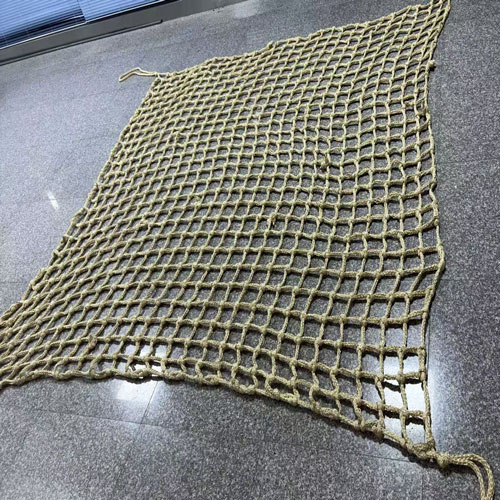
The phrase saving a little but losing a lot perfectly describes the danger of purchasing knotless aramid drone nets. Consider the following scenarios:
High-speed drone impact: A commercial quadcopter traveling at 50–80 km/h delivers a concentrated kinetic energy load. A knotless net's fiber intersections cannot withstand this sudden shear stress; the net tears apart, allowing the drone to penetrate the protected zone
Explosive-laden drone threat: Drones carrying explosive payloads generate not only impact force but also blast pressure waves. The knotless structure, lacking mechanical anchoring at junctions, fails catastrophically under these compound forces.
Continuous operation in harsh environments: Aramid nets are often deployed in high-temperature industrial areas, deserts, or coastal regions with salt spray
. Knotless nets, with their compromised structural integrity at weave points, degrade faster under cyclic loading, UV exposure, and thermal stress.
The TaiZhou Lift Sling Net Belt Factory understands these critical engineering principles. Our company specializes in manufacturing knotted aramid rope defense nets using precision-twisted, multi-strand aramid ropes with professionally tied knots. Each rope is constructed to ensure that under impact, all fibers within the rope work together in parallel, maximizing the aramid's inherent strength while eliminating the cross-cutting failure mechanism.
Proper knotted rope construction offers several decisive advantages for drone defense:
True parallel fiber loading: The twisted rope structure ensures that upon impact, tensile force is distributed evenly across all filaments, achieving the theoretical maximum strength of the aramid material.
Mechanical interlocking: The knots themselves create redundant load paths. Even if one rope segment fails, adjacent ropes and knots maintain the net's structural integrity, preventing complete penetration.
Superior energy absorption: The rope's twisted construction provides a degree of "structural damping" that helps dissipate impact energy, reducing peak stress on individual fibers.
Field repairability: Unlike knotless nets, which require specialized equipment to repair, knotted rope nets can be repaired in the field by re-tying knots at damaged sections.
Our knotted aramid drone defense nets meet the following critical specifications:
Operating temperature range: -40°C to 250°C (continuous), with short-term tolerance up to 400°C
Strength retention at high temperature: ≥85% at 250°C
Mesh size options: 8–20 mm (customizable to target drone size)
Interception success rate: ≥90% for consumer and industrial drones
Deployment time: <0.5 seconds via pneumatic, launcher, or ground deployment
Folded volume reduction: >80% for portability
These performance guarantees are only achievable through knotted rope construction. No knotless aramid net can match these specifications under real-world dynamic loading conditions.
The market currently offers a range of aramid drone nets at varying price points. Some suppliers advertise "cost-effective" knotless nets that appear similar to knotted products but use fundamentally different—and dangerously inferior—construction methods. The lower price reflects not efficiency but reduced material usage and compromised structural integrity.
When evaluating suppliers, buyers must ask:
What is the rope construction? Are the net ropes twisted multi-strand cords or individual monofilaments?
What is the knot configuration? Are professional knots used, or is the net knotless/interwoven?
What are the certified performance metrics? Does the supplier provide third-party impact test data?
For TaiZhou Lift Sling Net Belt Factory, we are transparent about our construction methods and performance data. Every knotted aramid net undergoes rigorous quality control:
Rope tensile strength testing
Knot integrity verification
Dynamic impact simulation
High-temperature aging tests
The science is clear: aramid fiber drone defense nets must use knotted rope construction. The inherent properties of aramid fibers—high strength but minimal elongation—demand a structural approach that eliminates fiber-to-fiber cross-cutting and ensures parallel load distribution. Knotless nets, while cheaper, represent a dangerous compromise that can lead to net failure exactly when it is most needed.
Don't let cost savings put lives and critical assets at risk. Insist on knotted aramid rope nets from verified manufacturers like TaiZhou Lift Sling Net Belt Factory (台州力吊索网带厂). Our products combine advanced materials science with proven construction techniques to deliver the highest level of drone defense reliability.
公 司:China Lifute Sling Group
联系人:Mss Wang
电话:+8613365203036
手机:+8613365203036
E-mail:cnlift@126.com
地 址:TaiZhou City, JiangSu Province, Lifute District ,China