语言选择: 



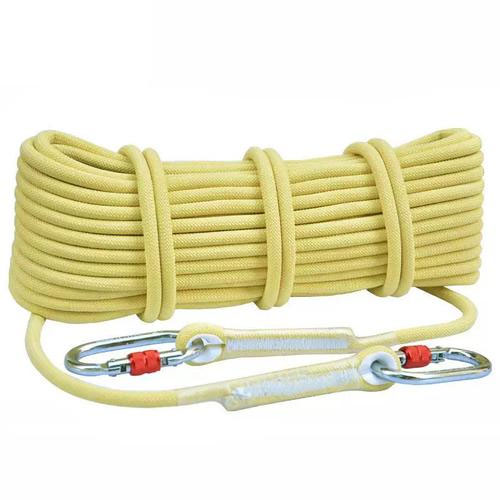
China Lifute Sling Group manufacture Aramid Cord Sling,Aramid sling,Fireproof lifting strap.
China Lifute Sling Group manufactures aramid cord slings in para-aramid (Kevlar®-grade) fibre — a lifting sling whose load-bearing body is a braided cord, not a flat woven belt. That single change of shape is what the product is for: a round cord section wraps a tight radius, chokes a narrow shackle or a bar without creasing, and keeps its full strength where a flat sling would be cut or cooked. The fibre does not melt and does not support combustion, so an aramid cord sling is the sling you reach for in a foundry, a steel mill, a glass plant, a welding bay or any overhead rigging job that has to satisfy a fire code.
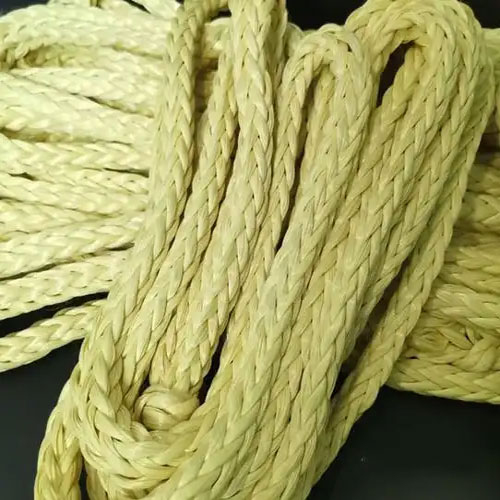
Every aramid cord sling we ship is built in two stages. The cord is braided, not twisted, so the aramid filaments stay parallel and are not forced to shear against each other at every turn. The braided cord is then closed into a loop with sewn eyes, spliced eyes or a tapered termination, depending on whether you need the sling to be re-inspectable, re-certifiable, or simply as compact as possible. Cord diameter, finished length, working load limit, eye size, cover and label data are all made to order.
A cord sling sits between three familiar products. It is not a flat webbing sling, which spreads load over a wide surface and is the right answer for a painted, polished or easily marked load. It is not an endless round sling, whose fibre core hides inside a woven sleeve. And it is not a wire rope sling, which will scratch what it touches and cannot be handled in a hot zone without gloves and a second thought. An aramid cord sling is a rope-bodied sling: one braided cord, closed into a loop, terminated at the ends, sized for a working load limit.
That shape decides where the product wins:
What it is not is a shock absorber. Aramid is a low-elongation fibre, so it stores very little energy and hands a shock load straight through to the load and the machine. If your duty includes dynamic loading, say so when you enquire: we will either up-rate the configuration or point you at a purpose-built recovery strop instead of selling you the wrong sling.
Three questions decide whether an aramid cord sling is the right product at all, and we ask them on every enquiry: what is the load; what does the sling have to wrap — the radius, the edge condition and the surface temperature of the thing it touches; and what standard does your lifting plan have to satisfy. Answer those three and the cord diameter, the termination, the cover and the safety factor follow from them. Skip them and you end up buying capacity you do not use, or missing capacity you needed.
| Property | Aramid cord sling | Polyester / nylon sling | Why it matters |
|---|---|---|---|
| Tensile strength to weight | Very high — a lighter cord carries the same rated load | Lower; more material needed for the same WLL | A smaller, lighter sling for the same duty, easier to handle overhead |
| Elongation at break | Low, approx. 3.6% – 4% [确认] | Polyester approx. 10–12%; nylon higher still | Load stays where it is set; multi-leg slings share load predictably |
| Heat / flame | Does not melt, does not support combustion; char-resistant | Melts and softens at low temperature; support combustion | Usable in foundries, steel mills, glass plants and hot-work zones |
| Cut and abrasion resistance | High; the fibre resists slicing by a machined edge or a burr | Moderate; cuts through at a sharp edge or a rough casting | Longer service life on steel, stone and scrap handling |
| Chemical resistance | Excellent against oils, fuels, solvents and most acids and alkalis | Good, but polyester is attacked by strong alkalis | Suitable for chemical plants, oil and gas and marine environments |
| Edge friendliness | Good; the round cord does not crease the way flat webbing does | Excellent against soft and painted surfaces | Choose aramid for sharp steel, polyester for finished surfaces |
| UV / weathering | Aramid alone is UV-sensitive — we supply a protective cover | Polyester is naturally UV stable | Specify a cover, or keep the sling out of permanent direct sun |
Two lines in that table are the honest trade-offs, and they are worth reading twice. Aramid is UV-sensitive on its own, which is why we supply a polyester, PU or rubber cover as an option and recommend it for any outdoor or permanently installed sling. And low elongation is a two-edged property: it is exactly what you want for precision placement, and exactly what you do not want in a shock-loaded line.
Two decisions in the specification decide how much of the aramid you paid for actually ends up carrying the load: how the cord is made, and how it is terminated.
The filaments are laid in parallel-helical paths by braiding. They are not forced to cut across one another at every turn, so the cord keeps the fibre's strength instead of spending a share of it on internal abrasion. On a low-elongation fibre such as para-aramid this matters more than on nylon: the less a rope stretches, the more the filaments grind wherever they cross, and twisted aramid cord loses measurable capacity to its own construction.
A sling is only as strong as its weakest end. We supply four terminations and will tell you which one suits your duty rather than defaulting to the cheapest:
A polyester, PU or rubber sleeve over the aramid cord buys three things: UV protection for the fibre, abrasion protection at the contact points, and a clean surface that will not mark a machined or coated load. If the sling will live outdoors or be dragged over steel, specify a cover.
| Configuration | How it is used | Typical duty |
|---|---|---|
| Single leg, eye-to-eye | One cord loop with an eye at each end; the workhorse configuration | General lifting, machine and mould handling, choke hitches |
| Endless loop / grommet | Closed loop with no termination hardware; can be threaded through a fixed eye | Choking, tensioning, pulling, tight-access rigging |
| Two, three or four leg bridle | Legs gathered into a master link, ring or shackle | Lifting an item that must stay level or share load between points |
| Covered aramid cord sling | Aramid cord inside a polyester, PU or rubber sleeve | Hot work, outdoor service, loads that must not be marked |
| Hardware-ended sling | Thimble, eyelet, master link, shackle or quick-release pin at one or both ends | Fixed anchor points, repeated connect and disconnect, jigs and fixtures |
| Small-diameter anchor sling | 6–10 mm cord, sewn connection, short finished length | Anchors, rigging above ground, rope access, stage and event rigging |
Outside industry, the phrase aramid cord sling is best known to climbers and rope-access technicians. A small-diameter aramid cord sling with a sewn connection behaves differently from a nylon sling in three useful ways: it is semi-stiff, so it holds its shape and can be placed one-handed in a reachy position instead of drooping out of reach; it has high cut resistance, so it survives contact with limestone, granite and rusty steel edges; and because the connection is sewn rather than knotted, there is no permanent bend radius inside the fibre that would otherwise damage filaments over time.
Two limits apply, and we would rather state them than let a customer discover them. An aramid cord sling is not a shock-absorbing runner and must never be used as a fall-arrest lanyard or as a dynamic belay component. And it should be inspected more, not less, than a nylon sling: para-aramid can lose a significant share of its capacity after a severe impact without showing external damage, so any sling involved in a shock event is retired, not re-used.
The table below is the starting point for a specification sheet, not a stock list. Everything is made to order against your load, hitch type, span and standard.
| Item | Range / standard |
|---|---|
| Material | 100% para-aramid fibre (Kevlar® 29 / 49 grade or Twaron® equivalent) |
| Cord construction | Braided, non-twisted; 8-strand or 12-strand [确认] |
| Cord diameter | 6 mm / 8 mm / 10 mm / 12 mm / 16 mm / 20 mm / 24 mm / 32 mm / 40 mm [确认] |
| Termination | Sewn eye, spliced eye, tapered loop or endless; thimble, eyelet or hardware optional |
| Working load limit | Made to order, approx. 0.5 t – 100 t per configuration [确认] |
| Safety factor | 5:1 / 6:1 / 7:1 — state the standard you work to and we build to it |
| Finished length | 200 mm to 100 m, custom; length measured eye to eye [确认] |
| Elongation at break | Approx. 3.6% – 4% [确认] |
| Heat resistance | Does not melt and does not support combustion; continuous service temperature [确认] |
| Cover | Optional polyester, PU or rubber anti-abrasion / UV sleeve [确认] |
| Colour | Natural aramid yellow; other colours and colour coding on request [确认] |
| Marking | WLL, length, material, safety factor, batch number and standard on the label |
| Documentation | Certificate of conformity and, on request, a break-test certificate and inspection record sheet |
| Reference weight | Approx. [确认] kg per metre at the cord diameter you specify |
The weight of the load is the easy part. The figure that sizes the sling is the load in each leg, which depends on the number of legs, the included angle between them and the mode factor of the hitch. A two-leg sling at 0° carries half the load per leg; widen the angle and the tension climbs quickly. A choke hitch derates capacity as well. Give us the load, the number of legs, the angle and the hitch and we will do this arithmetic with you rather than leave you to guess it.
Cord diameter is chosen from three constraints at once: the WLL you need, the smallest radius the sling must wrap, and the gap it must pass through. A thicker cord carries more load but is harder to thread through a tight pad eye and stiffer to handle. Where a large WLL has to pass through a small eye, the answer is usually more than one leg or a spliced termination rather than a thicker cord. Tell us the pin diameter or the slot width and we will work back from it.
Sewn eyes are compact, flexible and re-inspectable, and they suit the great majority of lifting duties. Spliced eyes give the cleanest profile and are usual at the very top of the capacity range. Endless loops are for choking and threading. Hardware — thimbles, eyelets, master links, shackles — is for fixed anchor points and for duty cycles where operators connect and disconnect the sling dozens of times a shift.
Specify a cover if the sling will be outdoors, dragged over steel or used where it must not mark the load. Specify colour coding and label data if slings are issued from a store, if several capacities are in circulation on the same site, or if your audit trail has to identify the sling by batch. None of these add much to the unit price, and all of them are cheaper than attributing an incident to an unidentifiable sling.
| If your priority is… | Specify | Why |
|---|---|---|
| Heat, flame and hot work | Aramid cord sling | Aramid does not melt and does not support combustion |
| A load that must not be marked | Polyester webbing sling with sleeves | Wide flat contact area spreads the bearing pressure |
| Tight radius, choke hitch, narrow shackle | Aramid cord sling or a round sling | Round section fits and chokes without creasing |
| Energy absorption and shock loading | Nylon sling, or a purpose-built recovery strop | Aramid stores almost no energy and must not take the shock |
| Frequent inspection and re-certification | Aramid cord sling with sewn, labelled eyes | The stitch line and label make condition and identity visible |
| Pulling and tensioning with minimum creep | Aramid cord sling | Low elongation keeps the load where you set it |
| Budget-first general lifting | Polyester webbing or round sling | Aramid costs more per tonne and is wasted where heat is not a factor |
We are a factory, not a trading company, so an aramid cord sling is built to your drawing rather than picked from a shelf. Send us the load, the hitch type, the span or the centre-to-centre length, the cord diameter you want or the space you have to pass through, the standard you work to and whether the environment is hot, wet, chemical or UV-exposed. We will come back with a recommended configuration, a drawing and a quotation.
Each batch of aramid cord is checked for construction, diameter and workmanship before it is assembled, and the finished sling is inspected against the drawing before it is labelled. Where a customer's standard requires proof load or break testing, we test to the nominated figure and issue the certificate with the shipment. Labels carry the working load limit, the finished length, the material, the safety factor and a batch number, so a sling can be traced back to its production record during an inspection.
Packing is agreed per order: slings coiled and tagged, sets kept together, pallets or cartons labelled with the item, the length, the WLL and the quantity. Tell us at the enquiry stage if you need the labels or the packing list in a specific format.
An aramid cord sling is a lifting sling whose load-bearing body is a braided aramid (Kevlar-grade) cord rather than flat webbing. The cord is formed into a loop and given sewn or spliced eyes, so the sling can be choked around a load, wrapped into a tight radius and used where a flat sling would be damaged by heat or cut edges.
A webbing sling spreads the load across a wide, flat surface and is the better choice for soft or easily marked loads. A cord sling concentrates the same fibre into a much smaller round section, so it wraps narrow shackles and tight radii, resists edge cutting better and takes up less space on a hook. Both are available in aramid from our factory.
We build aramid cord slings to order from approximately 0.5 t to 100 t per configuration, at the safety factor you specify. Because the WLL depends on cord diameter, splice or sew efficiency, termination and hitch type, send us the load, the hitch and the standard you work to and we will confirm the figure rather than quote a catalogue number.
Yes, and this is the main reason customers choose aramid. Aramid fibre does not melt and does not support combustion, so an aramid cord sling keeps its strength where polyester or nylon would soften. Because the exact continuous service temperature depends on cord diameter, cover material and exposure time, we confirm the value for each order.
No. Aramid is a low-elongation fibre, so it stores very little energy and passes a shock load straight through to the load and the machine. Use an aramid cord sling for controlled static lifting, and use a purpose-built recovery strop for kinetic work.
Yes. A small-diameter aramid cord sling with a sewn connection is a common anchor and rigging sling above ground and in rope access work: it is stiffer than nylon, so it is easier to place one-handed, and its cut resistance holds up on limestone and granite edges. It is not a shock-absorbing runner and must not be used as a fall-arrest lanyard.
Yes. Cord diameter, finished length, eye size, termination type, cover and label data are all made to your drawing or to your nominated standard. We are a factory rather than a trader, so we can also supply private-label slings and colour-coded batches.
Inspect before every use and formally at the interval your lifting plan requires. Look for chafed or fuzzy cord, cut filaments, a slipped or loose stitch line, thimble or eyelet wear, and chemical or heat discolouration. Retire the sling immediately after any shock load, any evidence of heat damage, or any damage that reaches the cord core, because aramid can lose capacity without visible external signs.
Send us the load, the hitch type, the finished length or the span, the cord diameter you want or the gap the sling has to pass through, the working temperature and the standard you work to. We will come back with a recommended configuration, a drawing and a quotation. If you are still at the concept stage, tell us the load and the environment and we will propose a specification.
Order online | Contact us | Send an enquiry
China Lifute Sling Group — Contact: Mss Wang | Tel / WhatsApp: +8613365203036 | E-mail: cnlift@126.com | Address: TaiZhou City, JiangSu Province, Lifute District, China
Further reading: company profile, company culture, what the colour of your sling actually certifies, how capacity changes with hitch type, how much a sling costs, where to buy webbing slings, which company manufactures webbing slings, downloads, help documents.